Detailed Deliberations Held on Exemption Provisions under the Code on
Social Security, 2020 & EPF Scheme, 2026, Amnesty Scheme-2026, and
Investment Management of Exempted PF Trusts
✓ Representatives of exempted establishments
from Noida, Bareilly, Agra, Meerut, and Greater Noida participated in the
workshop alongside Central board Members & senior EPFO officials.
✓ Detailed deliberations were held on exemption
provisions under the Code on Social Security, 2020, and the EPF Scheme, 2026.
✓ The Amnesty Scheme-2026 was discussed in
detail, offering eligible trusts a six-month window for Retrospective Trust
Regularisation.
✓ A dedicated technical session was held on
investment patterns, capital security, and prudent diversification for exempted
PF trusts.
✓ The programme concluded with the release of a
coffee table book and felicitation of participants.
New Delhi: Employees'
Provident Fund Organisation (EPFO), through its Regional Office, Noida,
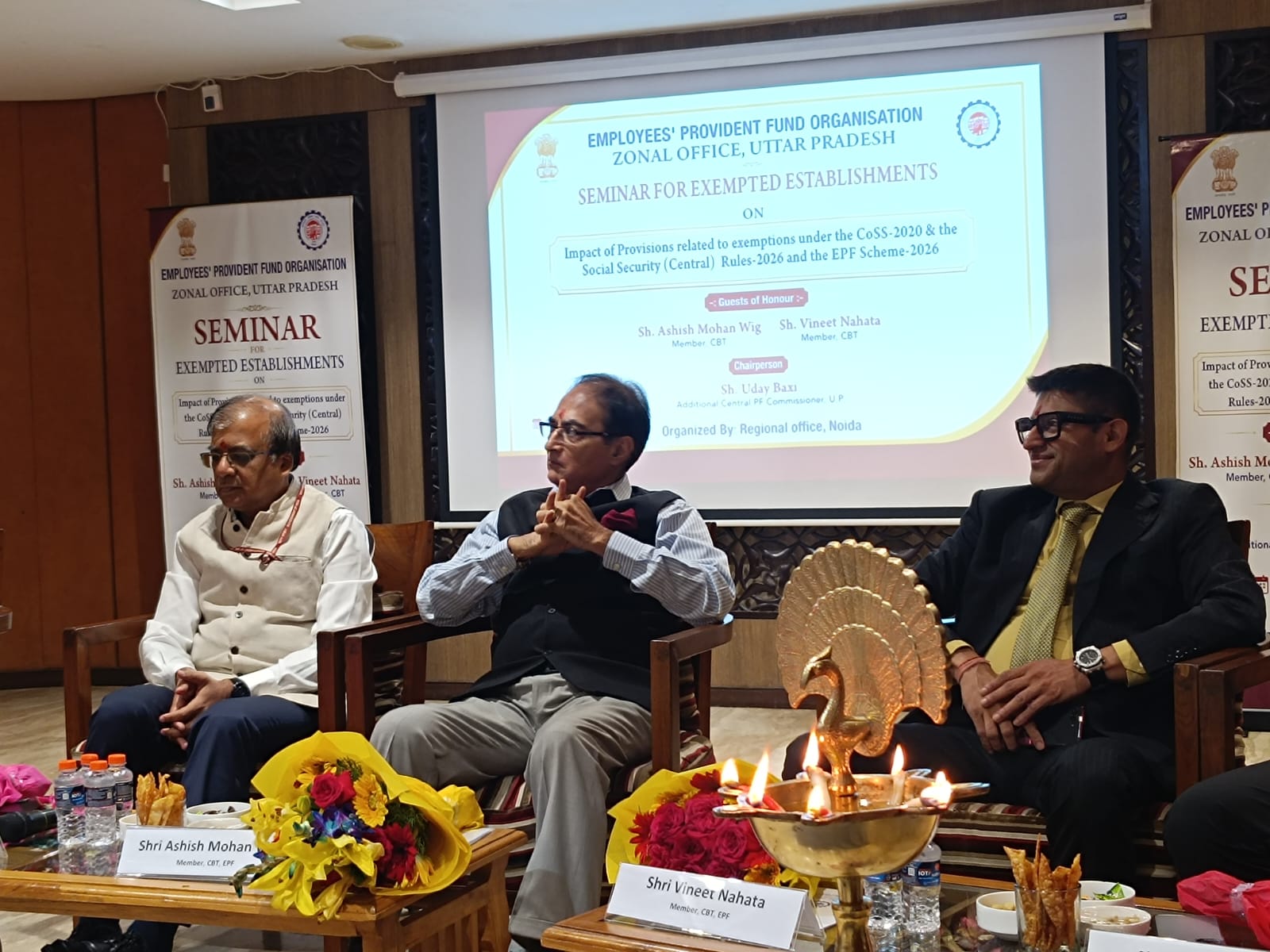
organised a Workshop for Exempted Establishments at ITC Fortune, Sector 27,
Noida, on July 31, 2026. The objective of the workshop was to brief exempted
establishments about the exemption provisions, Amnesty Scheme-2026, investment
management, and compliance frameworks under the Code on Social Security, 2020,
and the Employees' Provident Fund Scheme, 2026, while strengthening dialogue
between industry and EPFO.
The programme commenced with the lamp lighting and a formal welcome.
In his opening remarks, Shri Suyash Pandey, Regional Provident Fund
Commissioner-I, Noida, gave a brief introduction of the programme, emphasising
that continuous dialogue and timely compliance between industries and EPFO are
vital in the current landscape of evolving labour laws and digital
administration. This was followed by a round of introductions by the
participating employers.
Delivering the keynote presentation, Shri Pawan Kumar Singh, Regional
Provident Fund Commissioner-I (Uttar Pradesh Zone), explained in detail the
changes proposed in the exemption provisions under the Code on Social Security,
2020, and the EPF Scheme, 2026. He noted that the new framework makes the
process of granting and renewing exemptions more systematic, with the initial
exemption effective for 3 years subject to renewal upon fulfilling prescribed
conditions, and highlighted the proposed eligibility benchmarks including 500
contributing members and a cumulative fund of ₹50 crores. He also detailed the
mandates for digital record maintenance, timely online reporting, statutory
audits, and secure, time-bound transfer of members' provident fund balances in
case of expiration or withdrawal of exemption.
He further elaborated on the Amnesty Scheme-2026, describing it as a
one-time opportunity for establishments that operate recognised provident fund
trusts under the Income Tax Act but lack a formal exemption notification, to
apply within the stipulated period for Retrospective Trust Regularisation,
along with relaxations in certain eligibility criteria and resolution of
pending cases under defined conditions, remaining effective for six months from
the date of notification.
Shri Vineet Nahata, Member, Central Board of Trustees (CBT), conducted
a session on the investment pattern for exempted provident fund trusts. He
emphasised capital security, prudent diversification of investment portfolios,
and the balanced use of government securities, sovereign green bonds, and other
permitted investment instruments, reiterating that the employees' provident
fund is the cornerstone of their social security.
Addressing the gathering, Shri Ashish Mohan Wig, Member, CBT, shared
his perspective on governance and compliance for exempted trusts, underlining
the importance of robust trust management practices.
This was followed by an address by Shri Uday Baxi, Additional Central
Provident Fund Commissioner (UP Zone), who stated that the proposed provisions
of the Social Security Code, 2020, and the EPF Scheme, 2026, will make the
compliance system simpler, more transparent, and accountable. He interacted
with representatives of establishments covered under Regional Offices Noida,
Agra, Meerut, Bareilly & Greater Noida. All employers appreciated the
workshop and stated that they are satisfied with the services provided by the EPFO.
An interactive discussion session followed, during which senior EPFO
officials and representatives of exempted establishments engaged in an open discussion,
resolving participants' practical queries on exemption provisions, trust
management, and compliance.
The programme also featured the inauguration of a coffee table book,
followed by the presentation of mementoes to dignitaries and participants.
The proceedings concluded with a vote of thanks delivered by Shri
Kumar Raghvendra, Regional Provident Fund Commissioner-II, Noida, who expressed
gratitude to all guests, speakers, and participants, and expressed confidence
that the workshop would help establishments better navigate legal and
procedural changes and strengthen their compliance systems. The programme
concluded with the National Anthem, followed by media interaction and lunch.
In addition
to the CBT members and officers mentioned above, the event was also attended by
senior EPFO officials including Shri Ankur Gupta, Regional Provident Fund
Commissioner-I, Shri Vaibhav Singh, Regional Provident Fund Commissioner-I,
Shri Praveen Kumar, Regional Provident Fund Commissioner-II and Shri Mukesh
Saraswat, Regional Provident Fund Commissioner-II along with representatives of
IFFCO Aonla, Bajaj Hindustan Sugar Limited, RACL Geartech Limited, Rampur
Distillery and Chemical Co. Ltd. Employees PF Trust, DAV College Trust and
Management Society, Neoli Sugar Factory, Hindustan Unilever Limited, Indian Oil
Corporation, Dabur India Limited, Modicare Limited, Bharat Electronics Limited,
Shriram Pistons & Rings Ltd., Amrit Corp. Ltd., Dhampur Sugar Mills
Limited, Modi Industries, Sarla Chopra DAV Public School, Timex Watches
Provident Fund, India Government Mint, Food Corporation of India, Honda India
Power Products Limited, DENSO India Pvt Ltd., NTPC Dadri, DAV Public School
(NTPC Dadri), and Asian Paints Ltd., among other exempted establishments and
provident fund trusts.