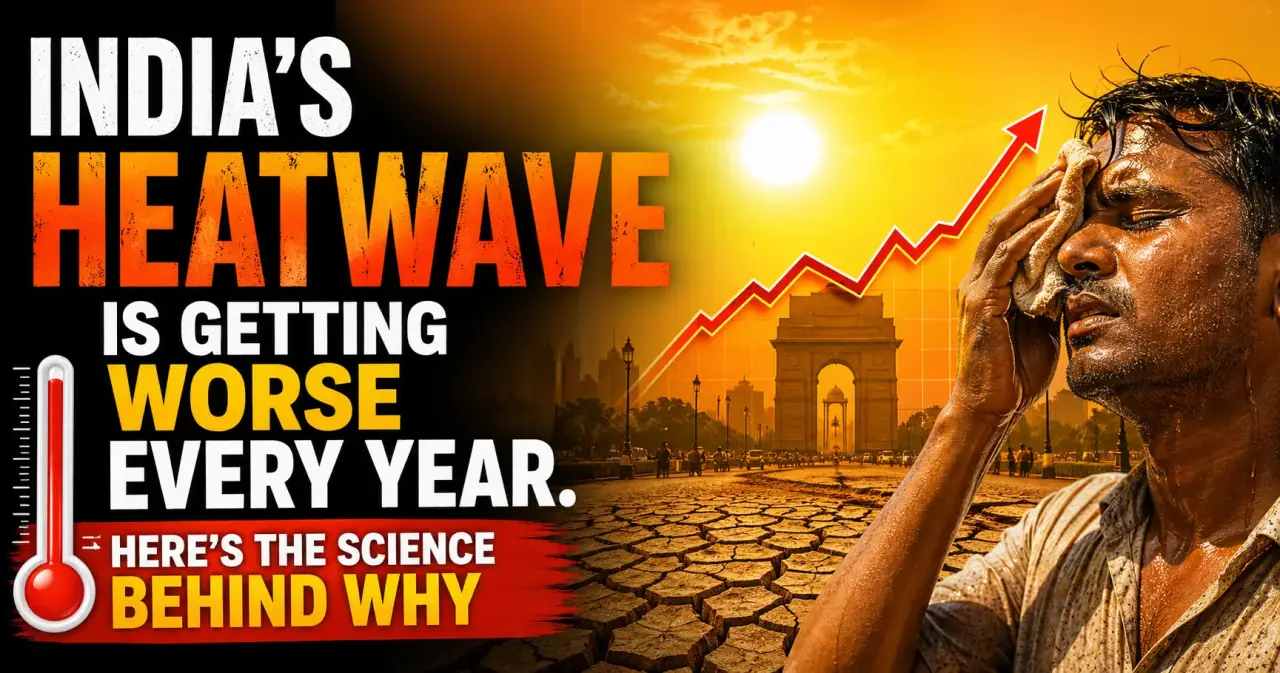
It Is Only April. So Why Does It Already Feel Like June?
If you stepped outside this month and thought "this does not feel normal," you were right.
India's 2026 heatwave arrived earlier than usual, with several regions already recording extreme temperatures in April, weeks before peak summer typically begins.
Temperatures in many parts of northwest, central and peninsular India are ranging between 40 degrees C and 44 degrees C, with the highest temperature of 44.5 degrees C recorded at Sri Ganganagar in Rajasthan.
This is not a one-off bad year. Scientists say India's summers are getting hotter, longer, and more dangerous. And there are very clear reasons why.
First, How Bad Has It Actually Gotten?
According to the India Meteorological Department, 2024 was India's warmest year since 1901, with temperatures about 0.65 degrees C above the long-term average, reflecting a clear climate change-driven warming trend and rising heat extremes.
Heatwaves that were earlier concentrated in the arid northwest and central India are now affecting humid coastal regions and even traditionally moderate areas. Over 57 percent of India's districts are now heat-prone, covering nearly 76 percent of the population.
In simple terms: more of India is getting hotter, and it is happening faster than before.
Reason 1: Climate Change Is Turning Up the Heat
The biggest reason behind all of this is global warming.
When we burn coal, petrol, and gas, we release gases like carbon dioxide into the air. These gases act like a blanket around the Earth, trapping heat that would otherwise escape into space. Over decades, this trapped heat has been slowly raising temperatures across the planet.
Rising greenhouse gas emissions are trapping heat and pushing temperatures higher every year. India, being a tropical country, is one of the worst affected.
Reason 2: Your City Is a Heat Trap
Have you ever noticed that cities feel much hotter than villages nearby? There is a scientific reason for that.
Rapid urbanisation has led to fewer trees and more concrete structures, creating what scientists call an "urban heat island effect," where cities stay hotter than surrounding rural areas. Concrete roads, glass buildings, and packed traffic all absorb heat during the day and release it slowly at night. This means cities never fully cool down, even after sunset.
Urban heat island intensity in India can be 1 to 5 degrees C higher than surrounding areas, and this effect is even more prominent at night, which worsens the severity of heatwaves because the body needs cooler nights to recover from daytime heat stress.
Reason 3: We Are Cutting Down Too Many Trees
Trees are nature's air conditioners. They absorb sunlight, release moisture, and keep the air around them cool. When we cut them down to build roads and buildings, we lose that cooling effect.
Urban green cover in several metropolitan regions has declined due to infrastructure expansion. Reduced vegetation limits natural cooling, disrupts microclimates, and increases surface temperatures.
Less shade means more heat absorbed by the ground. More heat absorbed by the ground means hotter air above it.
Reason 4: The Monsoon Is Becoming Unpredictable
India's summers are usually broken up by pre-monsoon showers that bring some relief. But that pattern is changing.
Delayed or weak pre-monsoon activity has reduced the chances of cooling rainfall, while dry continental winds prevent cooling and allow heat to build up over land.
Unstable monsoon cycles and changing wind patterns are disrupting India's natural weather rhythm and intensifying summer heat conditions.
When the rain does not come on time, heat just keeps building with nothing to break it.
Reason 5: El Nino Makes It Even Worse
Every few years, a weather event called El Nino warms up the Pacific Ocean. This might sound far away from India, but it has a direct effect on our weather.
Phenomena like El Nino contribute to rising temperatures and worsen heat conditions across India by disrupting wind patterns that normally bring cooler, wetter air toward the subcontinent.
When El Nino years line up with already hot summers, the results can be extreme.
Who Gets Hit the Hardest?
Not everyone suffers equally in a heatwave.
Vulnerable populations including the elderly, outdoor workers, and low-income communities with limited access to cooling infrastructure face the highest risk during extreme heat events.
Construction workers, farmers, delivery riders, and street vendors have no choice but to work outside in peak heat. For them, a heatwave is not just discomfort. It can be life-threatening.
The heatwave has already increased cases of dehydration, heat exhaustion, and heatstroke, particularly among vulnerable groups such as children, the elderly, and outdoor workers.
What Does the Future Look Like?
Honestly, it is not great unless things change.
India's heat crisis is becoming more widespread, frequent, and intense, turning into a major climate risk for the country. Disasters like heatwaves are estimated to cost India up to 2 percent of its GDP annually while eroding government revenue. That is billions of rupees lost every year, just because of heat.
Scientists say that without serious action on reducing emissions, planting trees, and redesigning cities to handle heat, things will only get more difficult.
What Can You Do Right Now?
While governments work on long-term solutions, here is what the IMD recommends for staying safe this summer:
Avoid prolonged exposure to direct sunlight, especially during peak afternoon hours. Stay adequately hydrated, wear light and breathable clothing, and avoid strenuous outdoor activities during high-temperature periods. Special care is advised for children, the elderly, and individuals with pre-existing health conditions.
The Bottom Line
India's heatwaves are not random bad luck. They are the result of decades of rising emissions, rapid city growth, shrinking forests, and shifting weather patterns, all piling on top of each other.
The good news is that we understand the science now. The question is whether that understanding will lead to real action, before summers stop being a season and start being a crisis.