Erasmus+ initiative brings together academia,
industry, and sustainability experts to strengthen circular economy pedagogy
and future-ready education.
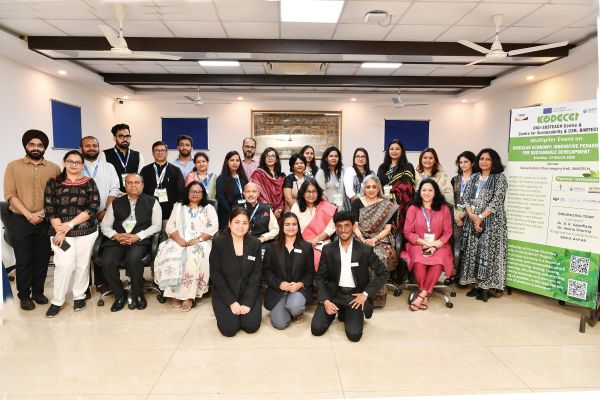
New Delhi: Birla Institute of Management Technology
(BIMTECH), Greater Noida, recently concluded two regional multiplier events
under the Erasmus+ funded KODECET (Knowledge Development for Circular
Economy Transition) project, focusing on advancing circular economy education and
promoting innovative pedagogical practices aligned with Sustainable Development
Goal 4 (Quality Education). The events brought together faculty members,
academic leaders, CSR professionals, sustainability practitioners, industry
representatives, and members of the DIGI-SUSTEACH and KODECET project teams. It
served as a collaborative platform to discuss how circular economy principles
can be systematically integrated into higher education curricula and teaching
practices.
Addressing the participants, Director Dr.
Prabina Rajib emphasized the evolving role of higher education, stating, “The
future of higher education lies in its ability to align knowledge with
responsibility. Circular Economy provides a powerful framework to prepare
students not only for careers, but for contributing to sustainable systems and
societal transformation.”
The event commenced with an overview of the KODECET
project, an international initiative involving institutions from India,
Thailand, and Europe, aimed at building capacity through curriculum
development, digital learning platforms, and industry engagement. A key
highlight of the event was the presentation of the KODECET three-course
framework, which provides a structured approach to circular economy education.
The framework includes conceptual foundations (“What & Why”),
implementation and delivery (“How”), and stakeholder-driven system leadership
(“With Whom”).
Dr. Veenu Sharma, National Lead – KODECET, highlighted, “Circular
Economy education must move from fragmented teaching to structured curriculum
design”. The sessions also explored the role of higher education in
fostering responsible citizenship, ethical leadership, and
sustainability-driven decision-making. Highlighting industry expectations, Dr.
K.K. Upadhyay, Professor and Chairperson, Centre for Sustainability and
CSR, BIMTECH, remarked, “Industry today requires professionals who can
translate sustainability into practice. This calls for deeper collaboration
between academia and industry and the integration of circular economy
principles into mainstream management education.”
The event incorporated innovative teaching methods,
including case-based learning, interactive discussions, and experiential tools
like the CIRCULA game, enabling participants to connect theory with real-world
applications.Participants expressed strong appreciation for the structured
approach to circular economy education. A faculty participant shared, “The
session provided clarity on how to move beyond isolated sustainability topics
and design integrated courses that are relevant to industry and society.”
Another participant from industry expressed, “The
focus on practical tools like ESG and carbon accounting makes this initiative
highly relevant for today’s business environment.”
The discussions also highlighted the increasing
demand for skills in areas such as circular business models, sustainable supply
chains, ESG reporting, and sustainability analytics. There was a clear
consensus on the need for continuous faculty development and institutional
support to scale circular economy education.Overall, the multiplier event
successfully contributed to the dissemination of KODECET project outcomes and
strengthened stakeholder engagement. It reinforced BIMTECH’s commitment to
responsible management education and global academic collaboration.
Through initiatives like KODECET, BIMTECH continues
to play a pivotal role in preparing future-ready graduates capable of
addressing complex sustainability challenges and contributing to the transition
toward a circular and regenerative economy.