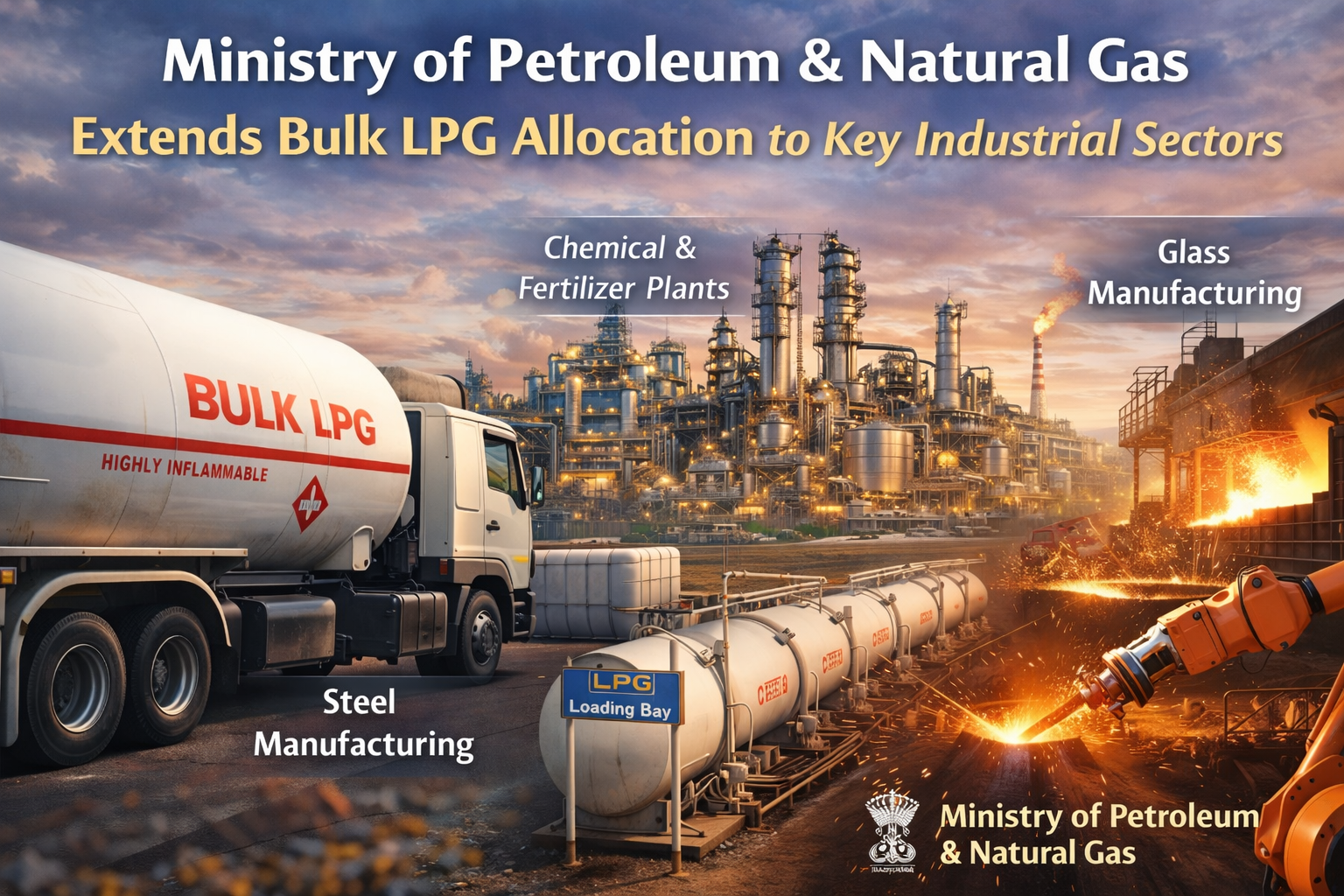
New Delhi: The Ministry of Petroleum & Natural Gas
(MoPNG) has issued an order to ensure continued and stable availability of
Liquefied petroleum gas (LPG) for industrial consumption amid evolving supply
conditions.
In a letter to all Secretaries to the
Government of India and All State and UT Chief Secretaries, Dr. Neeraj Mittal,
Secretary, MoPNG, said that industrial units in pharma, food processing,
polymer, agriculture, packaging, paint, steel, metal, ceramic, glass, aerosol,
foundry, forging, heavy water, uranium, and seed sectors will receive 70% of
their pre-March 2026 Bulk LPG consumption, subject to an overall sectoral
ceiling of 0.2 TMT per day. This builds on communications between March 16 and
27 with an additional 10% tied to Piped Natural Gas (PNG) reform milestones.
The approach ensures calibrated distribution of LPG while promoting a gradual
transition towards alternative fuel infrastructure.
The MoPNG has further said that industries
where LPG serves as a critical and non-substitutable input in the manufacturing
process will be accorded inter-se priority in allocation. For such sectors, the
requirement to apply for PNG connectivity has been waived, ensuring that
industrial operations remain unaffected while maintaining compliance with
stipulated conditions.
The Ministry has also drawn a clear
distinction between industries that use LPG as a fuel, which can transition to
PNG over time, and those for which LPG is an irreplaceable manufacturing
input.
Prime Minister Narendra Modi, and Union
Petroleum and Natural Gas Minister Hardeep Singh Puri have both emphasized the
need for stable domestic LPG despite the significant volatility in global
prices due to the conflict in West Asia. To this extent, the government has
chosen to absorb the rising prices by absorbing costs through Oil Marketing
Companies (OMCs), and rising domestic production, and not pass the full cost
burden to the consumer.
States and Union Territories have also been
advised to disseminate the provisions of the Natural Gas and Petroleum Products
Distribution (Pipelines and Other Facilities) Order, 2026 to all relevant
stakeholders, promptly utilise the additional reform-linked LPG allocation, and
expedite notification of the CBG policy communicated earlier, in line with the
Government’s broader efforts to strengthen energy accessibility and
infrastructure.
India imports 60% of its LPG and about 90%
of that normally transits Hormuz. When the route came under stress, monthly
imports fell from 2.04 million tonnes in February to 1.12 million tonnes in
March, a 45% collapse in 30 days.