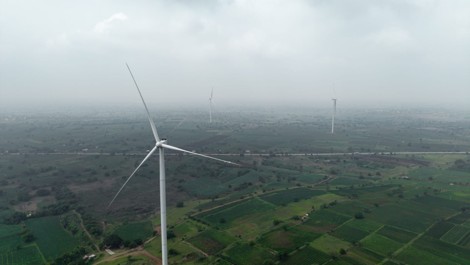
Tata Power Renewables commissions its 100.8 MW Ausa
Wind Project in Maharashtra, supplying renewable power to TPC-D
- Project to
generate 308 million units of clean electricity annually
- Project
expected to reduce approximately 2.52 lakh tonnes of CO₂ emissions every
year
- First-of-its-kind Monopole EHV line installation undertaken by TPREL’s Wind Project Execution Division
Mumbai: Tata Power Renewable Energy Limited (TPREL), a leading
player in India’s renewable energy sector and a subsidiary of The Tata Power
Company Limited (‘Tata Power’) has commissioned its 100.8 MW Wind Project in
Ausa, Latur, Maharashtra. The project will supply renewable power to TPC-D (Tata Power Mumbai Distribution) and is
expected to generate approximately 308 million units (MU) of electricity
annually, contributing to the supply of clean and reliable power.
The project comprises 28 Horizontal Axis Wind Turbine
Generators (WTGs), using the SG 3.6-145 model, with each turbine designed to
support efficient renewable power generation. With an annual generation
potential of 308 million units, the project is expected to help reduce
approximately 252,560 tonnes of CO₂ emissions every year, strengthening the
clean energy footprint of TPREL and supporting the transition towards a
lower-carbon power ecosystem.
One of the significant challenges emerged midway through
the project, when the grid connectivity plan was revised and the EHV line
configuration was changed from UG cable to Monopole. The revised configuration
involved substantial design, procurement and execution complexities and marked
the first-of-its-kind Monopole installation undertaken by TPREL’s Wind Project
Execution Division. Despite the change being introduced during project
execution, the team successfully incorporated the revised configuration, ensuring
that the overall project schedule remained unaffected.
With the commissioning of the 100.8 MW Ausa Wind Project,
TPREL’s total renewable utility capacity has reached 12.1 GW. Currently,
7.3 GW of this capacity is operational, comprising 5.9 GW of solar
and 1.4 GW of wind energy. Additionally, the remaining 4.8 GW is
under various stages of implementation.