Gurugram: Home Credit India, a leading consumer finance company,
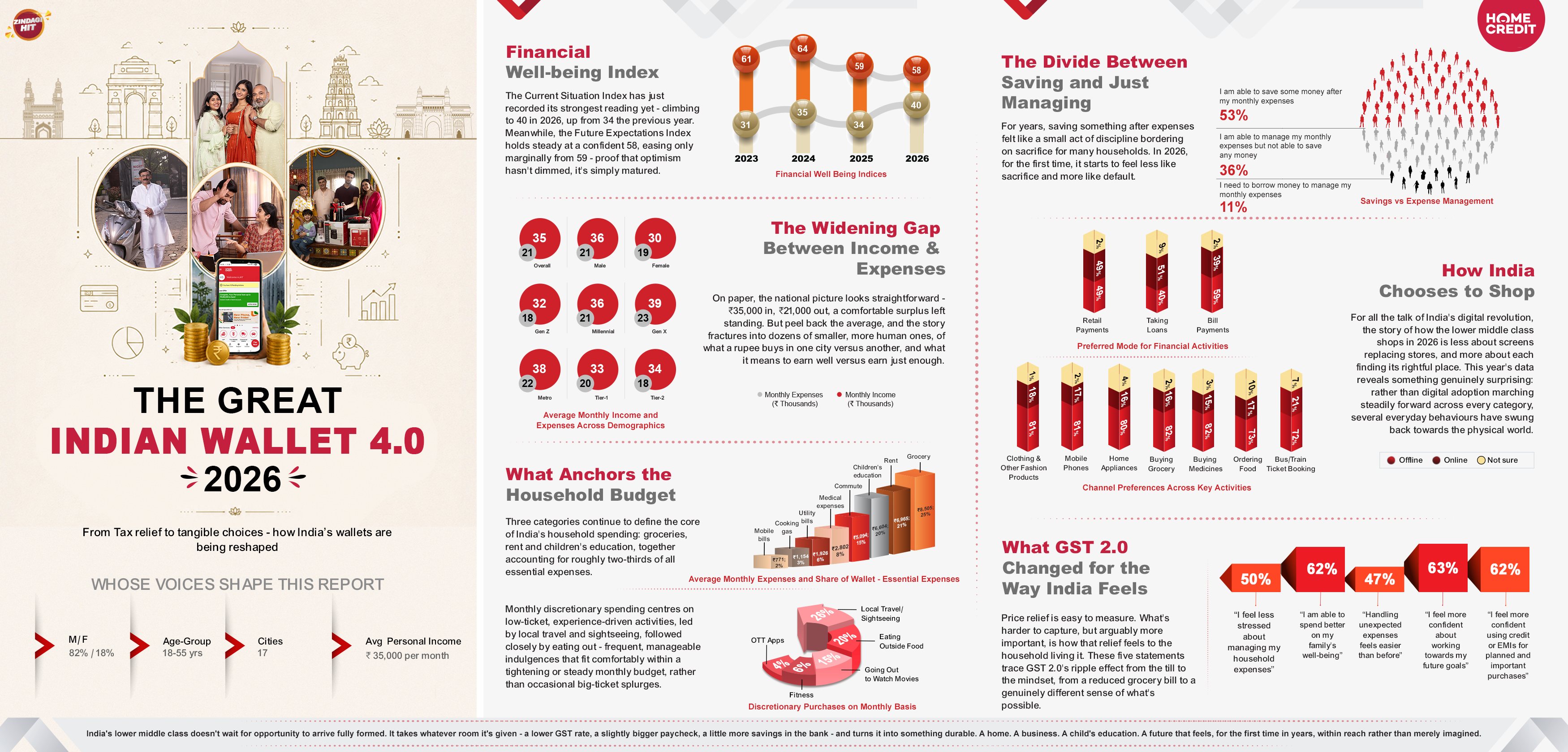
today unveiled the findings of the fourth edition of its annual report, The Great Indian Wallet
2026v, themed ‘From Tax
relief to tangible choices - how India’s wallets are being reshaped’. The
GIW 4.0 study reveals a notable shift in consumer sentiment, driven by greater
access to credit and the financial relief following GST reforms. Together,
these factors have eased the burden of everyday household expenses,
strengthened financial confidence, and reinforced prioritisation of
homeownership as the foremost long-term financial goal.
“When we initiated 'The Great Indian Wallet Study' in
2023, we sought to understand the financial pulse of India. What we discovered was a purpose driven and financially
prudent nation,” said Ashish
Tiwari, Chief Marketing & People Officer, Home Credit India. “This
year's findings reveal something extraordinary. Despite economic headwinds, the
tangible relief brought on by post-GST price revisions, paired with structured
financial tools, is smoothing their path toward wealth creation and
entrepreneurial expansion.”
Bhopal
has emerged as India's leading city for digital financial empowerment,
according to the Home Credit India Great India Wallet Study 2026, with
consumers demonstrating high confidence in technology-enabled financial
management, disciplined savings and rising investment behaviour. An
overwhelming 96% of respondents believe digital tools help them achieve their
financial goals, the highest among all surveyed cities. Additionally, 67% of
respondents are able to save after meeting their monthly expenses, an
8-percentage point increase over last year, reflecting growing financial
resilience.
Respondents
in Bhopal report an average monthly household income of ₹29,000 against monthly
expenses of ₹17,000, while contributing 63% of household expenses. Compared to
last year, the city recorded a 29-point increase in investment, an 7-point
increase in essential expenses and a 7-point increase in savings indicating a
strong shift towards long-term financial planning and wealth creation.
Essential
monthly expenses are led by groceries (27% wallet share), followed by commute
(18%), rent (17%), children's education (15%), medical expenses (10%), utility
bills (6%), cooking gas (4%), and mobile bills (3%).
On
discretionary spending, fashion and clothing (33%) remains the leading
category, followed by electronic devices (21%), travel (20%), home appliances
(15%), and home décor (4%). Looking ahead, respondents identify buying a house
(37%) as their foremost financial aspiration, followed by starting a business
(29%), saving for children's education (12%), paying off existing loans (12%),
and purchasing a car (9%).
To
achieve these aspirations, respondents identify access to credit at attractive
interest rates and flexible repayment tenures (33%) as the most important
financial enabler, followed by life insurance (9%), health insurance (8%),
fixed deposits (6%), gold investments (5%), and mutual funds/SIPs (3%).
Bhopal
also demonstrates relatively strong awareness of GST-related changes.
Seventy-one percent believe GST-related changes have improved spending on
family well-being. Consumers report noticeable price savings in two-wheelers
(26%) and cars (26%). Following GST 2.0, 14% of respondents are spending more
on better food quality and 9% on healthcare, reflecting an increasing focus on
household well-being alongside digital financial empowerment.
The
Great Indian Wallet 4.0 study was conducted with borrowers aged 18-55 years,
across 17 major Indian cities and varied income groups and professions.